


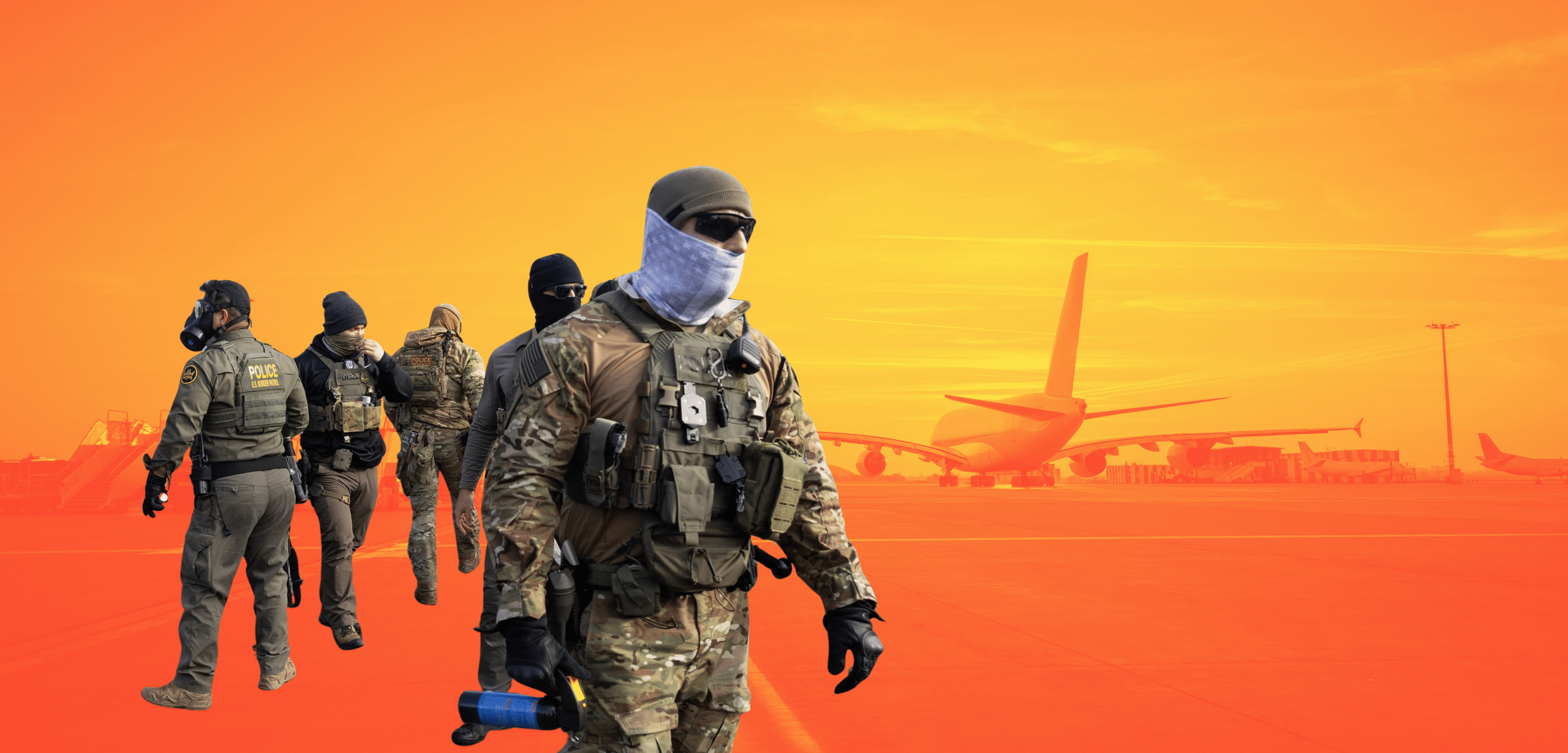
In March 2026, the Trump administration announced that it would be deploying ICE officers to airports to assist TSA agents with security during the partial government shutdown. The increased law enforcement presence—and particularly the increased presence of aggressive, violent ICE agents—is understandably a cause for concern for many travelers. This guide provides a general overview of your rights when interacting with ICE and other law enforcement officers at the airport.
Can an ICE Agent Stop and Question Me in an Airport?
Like local law enforcement officers an ICE Agent can approach you and ask you questions. However, they need to have reasonable suspicion to detain you for questioning against your will. If you are stopped by an ICE agent, you can ask them if you are free to leave.
If the agent says you are free to leave, you can end the encounter.
If the agent says no, you are being detained.
You do not have to answer any questions while you are detained. It is important to note that it is not legal to single out travelers for detention and questioning solely because of their race or ethnicity.
Can an ICE Agent Search My Bags in an Airport?
It is important to know that you have a lessened expectation of privacy in an airport.
In most situations, an ICE agent can conduct a warrantless search of your bags in an airport. Even if you have already went through an initial screening and there was nothing suspicious, a TSA or ICE agent can conduct a more thorough search of your bags so long as you are selected for an objective reason. It is not legal to subject a person to an additional search solely because of their race or ethnicity.
Can an ICE Agent Search My Phone and/or Computer in an Airport?
International airports are considered the “functional equivalent of a border,” making it legal for DHS agents to search phones and computers without reasonable suspicion if you are traveling internationally.
This is true for both citizens and non-citizens. While you can assert your rights and refuse to consent to a search, it could result in significant delays at the airport and could result in your devices being seized and searched. The Electronic Frontier Foundation provides helpful information on how to protect the privacy of your devices when traveling.
Can I Record ICE Agents at the Airport?
Generally, yes, you have a First Amendment right to record ICE agents who are performing their public duties in an airport.
However, airports are nonpublic forums unlike many other public places where people encounter law enforcement officers. Because an airport is a nonpublic forum, ICE agents will only need to articulate a reasonable basis to prohibit filming, this could include something as general as preventing disruptions at security checkpoints.
Should I Carry My Green Card or Other Immigration Documents with Me If I Am an Immigrant?
Yes. If you do not carry these papers with you, you could be charged with a crime.
An unexpired green card, I-94, Employment Authorization Card, Border Crossing Card, or other papers that prove you are in legal status should satisfy this requirement. Presenting false or expired papers to DHS may lead to removal or criminal prosecution.
Always keep a copy of your immigration papers with a trusted family member or friend who can send them to you, your lawyer, or DHS, if need be. Check with your immigration lawyer about your specific case.
Can I Sue ICE If They Violated My Rights?
Yes. Victims of ICE misconduct can sue the Trump administration directly by filing a FTCA suit.
Under the FTCA, a person who is injured, illegally detained, or has their property damaged by ICE agents can sue the United States government for damages. FTCA suits are complex with an intricate web of exceptions and provisos. But they are not impossible.
What Should I Do If I Think an ICE Agent Violated My Rights?
- Write down their name and any other identifying information that you can find, including a description of their physical appearance.
- Try to find witnesses and get their names and phone numbers.
- If you are injured, seek medical attention and take pictures of the injuries as soon as you can.
- Find a lawyer in your state using NPAP’s public directory. The process of suing federal officers and agents is incredibly complex. Be sure to choose an attorney with prior experience and training on how to handle these complicated cases.